
A negative marking calculator works out your net exam score after marks are taken off for wrong answers. To calculate negative marking by hand, multiply your correct answers by the marks per question, then subtract your wrong answers multiplied by the penalty. In NEET, 140 correct and 20 wrong answers give 140 × 4 − 20 × 1 = 540.
Negative Marking Calculator
Find your score after negative marking, see the correct answers you need for a target and check when a guess is worth it.
Exam patterns change. Use the marks and penalty printed in your own paper or notification.
This negative marking calculator has three tabs: Score, Target and Guess rule. On the Score tab you pick an Exam pattern from a menu, or enter your own Marks per correct and Negative per wrong. Quick buttons set the penalty as part of the marks: None, 1/5, 1/4, 1/3, 1/2, 2/3 and Custom. Then you enter Total questions, Correct answers and Wrong answers, and the tool shows the Unattempted number for you.
Click Calculate and you get four cards: Your score, Percentage, Accuracy and Negative marks. A bar and a set of boxes show how much the wrong answers cost you. The Target tab works backwards from a Target marks figure. Copy result and Copy link share the answer, and Reset clears the form. You can also use it as a negative marks calculator for any paper that has a penalty.
Below you will find the formula, worked examples for NEET and UPSC, the 1/3, 1/4 and 0.25 schemes, my own test with real numbers, and a way to decide whether a doubtful question is worth attempting.
What is a negative marking calculator?
A negative marking calculator is a score calculator for exams that take marks away for wrong answers. You enter what you got right and wrong, and it gives you a net score. It is also called a negative marks calculator, and the same tool works as a marks calculator with negative marking for any exam.
If you wonder how to calculate negative marking without a tool, the next section shows the formula. Negative marking exists to discourage blind guessing. A correct answer adds marks, a wrong answer removes some, and an unattempted question scores zero. The calculator does the sums for every question, so you can test a mock paper in seconds.
How to calculate negative marking
The formula is short.
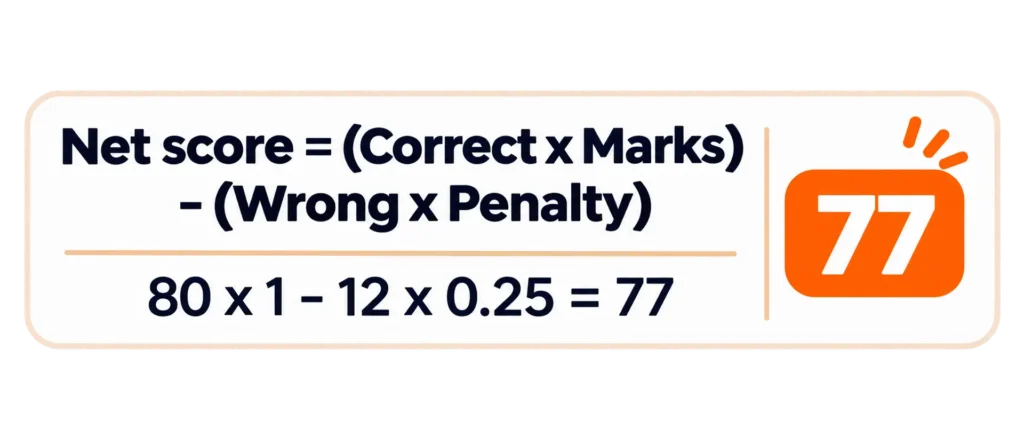
Net score = (correct answers × marks per question) − (wrong answers × penalty per wrong answer)
The penalty is usually a fraction of the marks for one question. If a question carries 1 mark and the penalty is one fourth, a wrong answer costs 0.25. Unattempted questions are not counted in the sum.
Here are the steps.
- Count your correct answers, wrong answers and unattempted questions. They should add up to the total number of questions.
- Multiply the correct answers by the marks per question.
- Multiply the wrong answers by the penalty.
- Subtract the second number from the first.
Take a paper with 100 questions, 1 mark each and a 0.25 penalty. You got 80 correct, 12 wrong and left 8 blank. The marks gained are 80 × 1 = 80. The marks lost are 12 × 0.25 = 3. The net score is 80 − 3 = 77.
How to use the negative marking calculator in 3 steps
This negative marking calculator runs on the page and needs no account. A result takes a few seconds.
Step 1: Pick your exam pattern and enter your answers
Open the Score tab. Choose an Exam pattern from the menu, such as SSC CGL Tier 1 (+2 / -0.5) or NEET UG (+4 / -1). The Marks per correct and Negative per wrong boxes fill in for you. Not on the list? Type your own numbers, or tap a button such as 1/4 or 1/3. Then enter Total questions, Correct answers and Wrong answers. The tool shows the Unattempted number. The menu itself says to check your latest notification, so do that first.

Step 2: Click Calculate and read the result
Click Calculate. Four cards show Your score, Percentage, Accuracy and Negative marks. A bar splits the marks into Net score, Lost to negative marking and Not scored. Below it, boxes show Attempted, Unattempted, Correct, Wrong, Score without penalty and Penalty cost. A line of text tells you how many wrong answers cancel one correct answer and the accuracy you need to make a guess worth the risk.

Step 3: Use the Target tab to plan
Open the Target tab of the negative marking calculator. Enter the Target marks you want and, if you like, the number of Attempts. The result gives Fewest attempts, Correct needed and Accuracy needed. A table lists several attempt levels, with the correct answers needed and the wrong answers allowed at each one.

My test: SSC CGL Tier 1 with 62 correct and 18 wrong
I opened the Score tab of the negative marking calculator and chose SSC CGL Tier 1 (+2 / -0.5). The tool set Marks per correct to 2, Negative per wrong to 0.5 and the 1/4 button to selected. I entered 100 for Total questions, 62 for Correct answers and 18 for Wrong answers. The tool showed Unattempted: 20. I clicked Calculate.
The cards showed Your score 115 out of 200, Percentage 57.5%, Accuracy 77.5% of attempted and Negative marks -9 from 18 wrong. The boxes showed Attempted 80, Unattempted 20, Correct 62, Wrong 18, Score without penalty 124 and Penalty cost 9 marks. The text read: Each wrong answer takes away 0.5 marks, so 4 wrong answers cancel one correct answer. You need at least 20% accuracy on a question before attempting it is worth the risk.
I checked each number by hand. 62 × 2 = 124. 18 × 0.5 = 9. 124 − 9 = 115. 115 ÷ 200 = 57.5%. 62 ÷ 80 = 77.5%. The 20% break-even matches the formula f ÷ (1 + f) with f = 1/4, which is 0.25 ÷ 1.25 = 20%. Everything matches.
Then I opened the Target tab of the negative marking calculator with the same pattern, 100 total questions, Target marks 120 and Attempts 85. The tool gave Fewest attempts 60 if all are correct, Correct needed 65 from 85 attempts and Accuracy needed 76.47%. The table listed these rows.
| Attempt | Correct needed | Wrong allowed | Accuracy |
|---|---|---|---|
| 60 | 60 | 0 | 100% |
| 70 | 62 | 8 | 88.57% |
| 80 | 64 | 16 | 80% |
| 85 (yours) | 65 | 20 | 76.47% |
| 90 | 66 | 24 | 73.33% |
| 100 | 68 | 32 | 68% |
By hand, with the formula (target + attempts × penalty) ÷ (marks + penalty), 85 attempts gives (120 + 85 × 0.5) ÷ 2.5 = 65. I checked all six rows the same way, and each one matches. The fewest attempts is 120 ÷ 2 = 60.
Exam patterns in the negative marking calculator
The Exam pattern menu of the negative marking calculator has presets for SSC CGL Tier 1, SSC CHSL Tier 1, NEET UG, JEE Main (MCQ), RRB NTPC, RRB Group D, IBPS / SBI Prelims, CUET UG, CAT, CLAT UG and UPSC Prelims (GS). Each one sets the marks and the penalty for you. The menu title says to check your latest notification, and you should, because exam bodies change schemes.
Here is the same result, 62 correct and 18 wrong, under the schemes in the menu. Each preset in this negative marks calculator sets the marks and the penalty for you. The totals are different for each exam, so the scores are not comparable. The table only shows how much the scheme changes the sum.
| Pattern in the menu | Marks / penalty | Net score |
|---|---|---|
| SSC CGL Tier 1, SSC CHSL Tier 1 | +2 / -0.5 | 115 |
| NEET UG, JEE Main (MCQ) | +4 / -1 | 230 |
| RRB NTPC, RRB Group D | +1 / -1/3 | 56 |
| IBPS / SBI Prelims, CLAT UG | +1 / -0.25 | 57.5 |
| CUET UG | +5 / -1 | 292 |
| CAT | +3 / -1 | 168 |
| UPSC Prelims (GS) | +2 / -2/3 | 112 |
Penalty per wrong answer: 1/3, 1/4 and 1/2
Searches such as 1 3 negative marking calculator and 1 4 negative marking calculator mean one third and one fourth. Every negative marks calculator needs two settings, the marks per question and the penalty. The fraction is applied to the marks of one question. The table shows the penalty for a wrong answer in each case.
| Marks per question | 1/3 penalty | 1/4 penalty | 1/2 penalty |
|---|---|---|---|
| 1 | 0.33 | 0.25 | 0.50 |
| 2 | 0.67 | 0.50 | 1.00 |
| 2.5 | 0.83 | 0.63 | 1.25 |
| 4 | 1.33 | 1.00 | 2.00 |
Read the table by row. A 2-mark question with a 1/4 penalty costs 0.5 for a wrong answer. A 4-mark question with a 1/4 penalty costs 1. That last case is the NEET scheme.
A quick way to feel the scheme: with a 1/3 penalty, 3 wrong answers cancel 1 correct answer. With a 1/4 penalty, 4 wrong answers cancel 1 correct answer. With NEET’s +4 and −1, 4 wrong answers also cancel 1 correct answer.
1/3 negative marking calculator and the UPSC negative marking calculator
UPSC Prelims uses a one-third penalty. Based on the exam pattern published on ClearIAS, GS Paper 1 has 100 questions at 2 marks each, for 200 marks. CSAT has 80 questions at 2.5 marks each, for 200 marks. A wrong answer loses one third of the marks for that question, and an unattempted question loses nothing. CSAT is a qualifying paper with a 33% minimum, which is 66 marks out of 200. Check the current UPSC notification for the official rule.
For a UPSC negative marking calculator, the penalty is 2 ÷ 3 = 0.667 marks in GS Paper 1 and 2.5 ÷ 3 = 0.833 marks in CSAT. Many sources round these to 0.66 and 0.83. In the negative marking calculator, pick UPSC Prelims (GS) (+2 / -2/3) for GS Paper 1. For CSAT, enter 2.5 marks and a penalty of 0.83.
Take GS Paper 1 with 60 correct and 20 wrong answers. The marks gained are 60 × 2 = 120. The marks lost are 20 × 0.667 = 13.33. The net score is 106.67. If you use the rounded 0.66, you lose 13.2 and get 106.8. That small gap is why two tools can show slightly different totals. Neither is wrong, but they round differently.
A CSAT example: 30 correct and 10 wrong. Marks gained: 30 × 2.5 = 75. Marks lost: 10 × 0.833 = 8.33. Net score: 66.67, which is just above the 66-mark line. With 29 correct and 11 wrong, the net score is 63.33, which is below it.
1/4 and 0.25 negative marking calculator
A 0.25 negative marking calculator is for papers where each question is worth 1 mark and a wrong answer costs a quarter of it. Many bank-style papers use this pattern, though each exam notice sets its own rule.
The earlier example showed 80 correct and 12 wrong giving 77. Take another. In a paper with 2-mark questions and a 1/4 penalty, a wrong answer costs 0.5. With 60 correct and 20 wrong, the marks gained are 120, the marks lost are 10, and the net score is 110.
In the negative marking calculator, the 1/4 button gives a penalty of 0.25 on a 1-mark question and 0.5 on a 2-mark question. The word to watch is quarter of what. A quarter of 1 mark is 0.25. A quarter of 2 marks is 0.5. A quarter of 4 marks is 1.
How to calculate NEET marks with negative marking
NEET UG has 180 questions for 720 marks. According to the NTA scheme reported for 2026, a correct answer gives +4, a wrong answer gives −1, and an unattempted question gives 0. ETV Bharat’s report on the NEET UG 2026 re-exam pattern says negative marking stayed in place. Always check the current NTA bulletin before you rely on a scheme.
To calculate NEET marks with negative marking, use this version of the formula. In the negative marking calculator, pick NEET UG (+4 / -1) from the Exam pattern menu.
NEET marks = (correct × 4) − (wrong × 1)
Take 140 correct and 20 wrong, with 20 left blank. The marks gained are 140 × 4 = 560. The marks lost are 20. The score is 540.
The table shows more cases. This is how to calculate NEET marks with negative marking for any attempt level.
| Attempted | Correct | Wrong | Blank | NEET score | Accuracy |
|---|---|---|---|---|---|
| 180 | 180 | 0 | 0 | 720 | 100% |
| 180 | 160 | 20 | 0 | 620 | 88.9% |
| 170 | 150 | 20 | 10 | 580 | 88.2% |
| 160 | 140 | 20 | 20 | 540 | 87.5% |
| 160 | 120 | 40 | 20 | 440 | 75.0% |
| 150 | 130 | 20 | 30 | 500 | 86.7% |
Look at the third row. Ten blank questions kept the score at 580. Compare the first two rows. Moving from 180 correct to 160 correct and 20 wrong costs 100 marks. Each wrong answer costs 5 marks compared with a right one, 4 marks you did not earn and 1 you lost.
How many correct answers do you need for a target score?
You can also work backwards. If you attempt a questions and want a target score, the correct answers needed are
correct = (target + attempted × penalty) ÷ (marks per question + penalty)
Round up to the next whole number.
For NEET with a target of 600, the penalty is 1 and the marks per question are 4. If you attempt 160 questions, you need (600 + 160) ÷ 5 = 152 correct. Check it: 152 × 4 = 608, minus 8 wrong answers, gives 600. If you attempt 170 questions, you need 154 correct. If you attempt 180, you need 156 correct.
The Target tab of the negative marking calculator does this sum and lists several attempt levels. In my test, a target of 120 out of 200 needed 65 correct from 85 attempts. Notice what happens. Attempting more questions asks for more correct answers, because the extra wrong ones cost marks. Your accuracy goal rises with every extra attempt.
For GS Paper 1 with a target of 100 marks out of 200, attempting 80 questions, the formula gives (100 + 80 × 0.667) ÷ (2 + 0.667) = 57.5. Round up to 58 correct. Check it: 58 × 2 = 116, minus 22 × 0.667 = 14.67, gives 101.33. With 57 correct, the score is 98.67.
Should you attempt a doubtful question?
The maths behind any negative marking calculator gives a simple break-even point. If the penalty is a fraction f of the marks for a question, a guess pays off only when your chance of being right is above f ÷ (1 + f).
| Scheme | Break-even chance of being right |
|---|---|
| 1/3 penalty | 25% |
| 1/4 penalty (including NEET) | 20% |
| 1/2 penalty | 33% |
Here is what this means with four answer choices. A pure guess has a 25% chance. Under a 1/3 penalty, a pure guess is worth 0.25 × 1 − 0.75 × 0.333 = 0 marks on average, so nothing is gained or lost. Under a 1/4 penalty, it is worth +0.0625 of a mark per question. Under a 1/2 penalty, it loses 0.125 on average.
If you can remove one wrong option, your chance rises to 1 in 3. Under a 1/3 penalty, that is worth 0.111 of a mark per question. In NEET, a pure guess is worth 4 × 0.25 − 0.75 = +0.25 marks, and a guess with one option removed is worth +0.67 marks.
The calculator shows this break-even line under every result. In my SSC CGL test it said you need at least 20% accuracy on a question before attempting it is worth the risk. The tool also has a Guess rule tab.
These figures are averages over many questions. A single question can still go either way, and the scheme for your exam may differ. Use the numbers to understand the risk, and then follow your own exam strategy and the paper’s instructions.
Use the negative marking calculator for mock tests
A mock test score tells you less than the three numbers behind it: correct, wrong and blank. After each paper, enter them in the negative marking calculator and note the net score and the marks lost.
Then compare two papers. If the marks lost from wrong answers are 25 in one paper and 12 in the next, your accuracy is improving even if the raw score barely changed. Track accuracy too. It is the correct answers divided by the attempted ones, so 140 correct out of 160 attempted is 87.5%.
To turn a score into a percentage, divide by the maximum marks. Our percentage calculator for marks does it for you. To see how much your score rose between two mocks, use the percentage increase calculator.
Common mistakes
These slips affect any negative marks calculator, and they trip up anyone learning how to calculate negative marking.
- Taking the penalty from the wrong base. A quarter of a 4-mark question is 1, not 0.25.
- Counting blank questions as wrong. They score zero.
- Forgetting that the total questions must equal correct, wrong and blank added together.
- Using 0.33 in one place and 0.333 in another and wondering why totals differ.
- Using the scheme of one exam for another. Read your paper’s instructions.
- Assuming old rules still apply. Marking schemes can change between years.
- Judging a mock by the raw score and ignoring the marks lost.
- Trusting a preset without checking it. The menu says to check your latest notification.
Disclaimer
This negative marking calculator is for practice and planning. It does not replace the marking scheme in your exam notification or answer key. Exam bodies set their own rules and can change them, including the penalty, rounding and qualifying marks. Check the official notice for your exam before you rely on a result.
Quick answers before you start
How to calculate negative marking?
Multiply correct answers by the marks per question, multiply wrong answers by the penalty, and subtract. For 80 correct and 12 wrong at 1 mark with a 0.25 penalty, the score is 80 − 3 = 77.
How to calculate NEET marks with negative marking?
Use (correct × 4) − (wrong × 1). For 140 correct and 20 wrong, the score is 560 − 20 = 540. Unattempted questions score zero.
What does 1/3 negative marking mean?
A wrong answer loses one third of the marks for that question. For a 2-mark question, that is 0.67 of a mark.
What is 0.25 negative marking?
A wrong answer loses 0.25 of a mark. It is a quarter of a 1-mark question.
Are unattempted questions penalised?
No. In the schemes covered here, a negative marks calculator treats an unattempted question as zero. Confirm this in your exam notice.
Does UPSC use 0.66 or exactly one third?
The rule is one third of the marks for the question. Many sources round it to 0.66 for GS Paper 1, so small differences between tools come from rounding.
Open the negative marking calculator, pick your exam pattern, enter your correct and wrong answers, and read the net score. Then check the break-even chance in the table above before you plan how many doubtful questions to attempt.