
A ppm calculator turns the amount of a substance and the amount of its solution into parts per million. Pick a mode, type your numbers and the tool shows the answer with the formula it used.
PPM Calculator
Calculate parts per million from concentration values, convert ppm to mg/L, convert between concentration units, work out a dilution, or find how much solute you need for a target ppm. Results update as you type. Everything happens inside your browser.
Concentration values
Total solution = solute + solvent
Solute and solution are the totals you have. If you enter a volume, the tool uses the density to find the solution's mass. Water and dilute solutions have a density of 1.
PPM to mg/L
For water and dilute solutions the density is 1, so 1 ppm equals 1 mg/L. Change the density only for strong solutions such as brine, syrup or milk.
Convert units
Density only matters when you convert between mass per volume (mg/L, g/L) and mass per mass (ppm, %, mg/kg). Keep it at 1 for water and dilute solutions.
Dilution
Uses C1 x V1 = C2 x V2. V1 is the stock you take, V2 is the total volume after you add diluent. Volumes are treated as additive.
Target
Gives the mass of solute to add to a solution of this size. For strong solutions the solute adds volume, so top up to the final volume after dissolving.
Result
This ppm calculator has five modes. PPM from concentration values works out ppm from a solute and a solution. Convert PPM to mg/L moves between the two units. Convert concentration units switches between ppm, ppb, percent and more. Dilution uses C1 x V1 = C2 x V2. Solute needed for a target PPM tells you how much to weigh out.
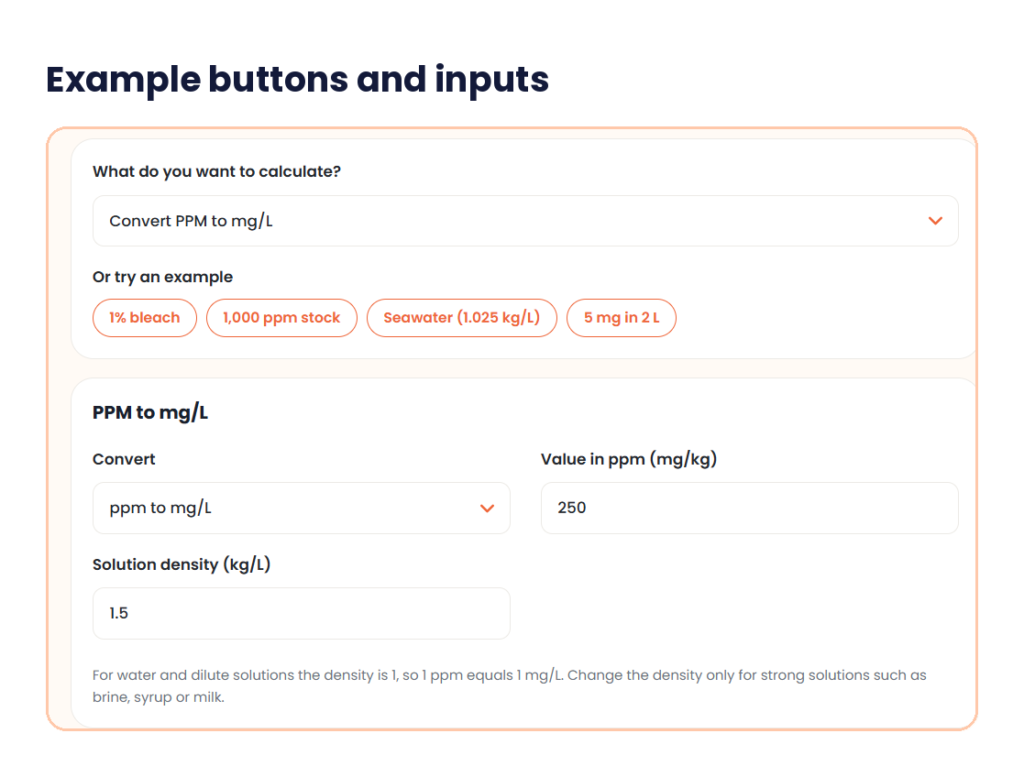
Under the mode box, Or try an example buttons let you test the tool before you type: 1% bleach, 1,000 ppm stock, Seawater (1.025 kg/L) and 5 mg in 2 L. Every result shows a Formula line. Reset clears the form, and Copy link and Copy results share or save the answer.
What does ppm mean?
PPM means parts per million. One ppm is one part of a substance in a million parts of the whole. If you have 1 mg of salt in 1,000,000 mg of solution, which is 1 kg, that is 1 ppm.
Ppm has no unit of its own. It is a ratio, so you need to know what is being compared. It can be mass in mass, volume in volume, or mass in volume. In water testing the usual form is mass in volume, written as mg/L. The parts-per notation article explains the family of units.
That is why a ppm calculation can go wrong. Two people can quote the same number and mean different things. The tool labels mass-based ppm as ppm (mg/kg) and volume-based values as mg/L, so you can see which one you have.
How to calculate ppm
The formula is ppm = (solute ÷ solution) x 1,000,000. Use the same unit for both amounts, and use the total solution, not only the solvent.
Take 5 mg of salt in 2 kg of salt solution. A ppm calculator would give the same answer. Two kilograms is 2,000,000 mg, so 5 ÷ 2,000,000 x 1,000,000 gives 2.5 ppm. If the answer looks very large or very small, count the zeros again.
For a mass and volume form, mg/L = solute in mg ÷ solution in litres. For dilute water, 1 mg/L is about 1 ppm. The ppm calculator does the sum for you.
How to use the PPM calculator in 3 steps
It runs on the page and needs no account. A single calculation takes under a minute.
Step 1: Pick a mode and enter your values
Open the box called What do you want to calculate? and choose a mode. Or tap one of the example buttons to see how a mode works. Then fill in the boxes. Convert PPM to mg/L, for example, asks for the value in ppm (mg/kg) and the solution density in kg/L. A note explains that for water and dilute solutions the density is 1, so 1 ppm equals 1 mg/L. Change it only for strong solutions such as brine, syrup or milk.
Step 2: Read the result and the formula
The Result card shows the answer in large type, with the density used under it. A Common units list shows ppm (mg/kg), ppb, percent (w/w) and mg/L together. If you picked a dense liquid, an amber note warns that mg/L and ppm differ. The Formula line shows every step. Use Copy results to save the numbers, or Copy link to share them.

Step 3: Try dilution or target ppm
Dilution has a Solve for menu. Pick Final concentration (C2), Stock volume needed (V1), Final volume (V2) or Initial concentration (C1), then choose a concentration unit and a volume unit. The ppm calculator treats volumes as additive. Solute needed for a target PPM asks for a target concentration, a solution volume and a density, and gives the mass of solute to add.

My tests: four modes, real numbers
I ran four modes of the ppm calculator with simple inputs.
PPM from concentration values. I used the example 5 mg in 2 L with density 1. The tool gave 2.5 ppm, equal to 2.5 mg/L, with 2,500 ppb and 0.00025 % (w/w). The formula line read mg/L = 5 mg ÷ 2 L = 2.5 mg/L, then ppm = 2.5 ÷ 1 = 2.5 ppm.
Convert PPM to mg/L. I entered 250 ppm with a density of 1.5 kg/L. The result was 375 mg/L, which is 250 x 1.5. The Common units list showed 250 ppm, 250,000 ppb, 0.025 % and 375 mg/L. The amber note read: at 1.5 kg/L, 100 ppm is 150 mg/L.
Convert concentration units. I entered 1,000 ppm and chose ppb as the target. The tool showed 1,000,000 ppb. The All units list also gave 0.1 % (w/w), 1,000 mg/kg, 1 g/kg, 1,000 mg/L and 1,000,000,000 ppt. Its formula line says 1 % = 10,000 ppm and 1 ppm = 1,000 ppb.
Solute needed for a target PPM. I set 50 ppm, 500 mL and a density of 1. The tool gave 25 mg, shown as 0.025 g. The formula read solute (mg) = ppm x solution mass (kg) = 50 x 0.5 = 25 mg.
I checked each one by hand. They all match.
PPM to mg/L and 1 ppm to mg/L
For water and dilute solutions, 1 ppm to mg/L is simple. One litre of water weighs about 1 kg, which is 1,000,000 mg. So 1 mg in 1 L is 1 part in 1,000,000. That makes 1 ppm equal to 1 mg/L.
Dense liquids need a correction. The tool uses mg/L = ppm x density, with density in kg/L. Going the other way, ppm = mg/L ÷ density. The table shows the effect.
| PPM | mg/L in water (density 1) | mg/L at density 1.5 |
|---|---|---|
| 1 | 1 | 1.5 |
| 10 | 10 | 15 |
| 100 | 100 | 150 |
| 250 | 250 | 375 |
| 1,000 | 1,000 | 1,500 |
The ppm calculator’s seawater example sits in between. At the tool’s 1.025 kg/L, 100 ppm is 102.5 mg/L. Most drinking water, garden and pool readings are dilute, so density 1 is a safe start. For a salty brine or a thick syrup, enter its real density.
PPM, ppb and percent
To change units, remember two steps. Multiply ppm by 1,000 for ppb. Divide ppm by 10,000 for percent.
| PPM | PPB | Percent |
|---|---|---|
| 1 | 1,000 | 0.0001% |
| 10 | 10,000 | 0.001% |
| 100 | 100,000 | 0.01% |
| 1,000 | 1,000,000 | 0.1% |
| 10,000 | 10,000,000 | 1% |
The Convert concentration units mode of the ppm calculator does both steps and also lists ppt, mg/kg, g/kg, mg/L and g/L. A 1% solution is 10,000 ppm. A 0.05% bleach solution is 500 ppm. For a plain percentage change between two numbers, use our percentage increase calculator.
PPM solution: dilution and target ppm
A ppm solution is a liquid made to a set strength. The last two modes of the ppm calculator build one.
For dilution, use C1 x V1 = C2 x V2. Say you have a 1,000 ppm stock and need 250 mL at 20 ppm. Then V1 = 20 x 250 ÷ 1,000 = 5 mL. Take 5 mL of stock and add diluent until the total is 250 mL. The Solve for menu lets you rearrange the same formula to find C1, C2 or V2 instead.
For a target ppm, the tool gives the mass to weigh. For 500 mL at 50 ppm in water, you need 25 mg of solute. That is a tiny amount, so a balance that reads to 0.001 g helps. For very small doses, make a stronger stock first and dilute it.
The ppm calculator adds one more useful note. For strong solutions the solute itself adds volume, so dissolve it first and then top up to the final volume.
Where you will use a ppm calculator
Drinking water. Total dissolved solids are reported in mg/L or ppm. The BIS standard IS 10500 lists 500 mg/L as an acceptable limit, with a higher permissible value where no other source exists. Check the current standard, and use a lab test for any safety decision.
TDS meters. A meter measures conductivity and multiplies it by a factor, often between 0.5 and 0.7. Two meters can show different ppm for the same water, so compare readings from one meter over time.
Swimming pools. Chlorine and stabiliser are given in ppm. Read your test kit instructions before you adjust anything.
Gardens and hydroponics. Nutrient mixes are given in ppm. A ppm calculation helps you mix a feed from a stock bottle.
Labs and schools. In a lab, ppm means a trace amount, and standard solutions use it too. A good ppm calculation calculator saves time and shows each step.
Common mistakes
These slips affect any ppm calculator, so check them before you trust a number.
- Using the mass of the solvent and not the total solution. Solute plus solvent is the solution.
- Mixing mg and g, or mL and L, in the same sum.
- Treating 1 ppm as 1 mg/L for a dense liquid. Enter the density.
- Mixing up the same substance reported on different bases, such as hardness as CaCO3 and the ion itself.
- Rounding in the middle of a calculation. Round once at the end.
- Skipping the lab for drinking water or chemical dosing. An online tool gives an estimate.
Disclaimer
This ppm calculator gives estimates for general information. It does not replace a lab test, a safety data sheet or advice from a qualified person. Do not use it alone to decide if water is safe to drink or to dose a pool. Read the product label and follow local rules.
Quick answers before you start
What does ppm mean?
Parts per million. One ppm is one part of a substance in a million parts of the whole. It is a ratio with no unit of its own.
How to calculate ppm by hand?
Divide the solute by the total solution and multiply by 1,000,000. Both amounts need the same unit. For water, ppm is about the same as mg/L. The ppm calculator does the sum for you.
Is 1 ppm to mg/L always 1 mg/L?
Not always. It holds for water and dilute solutions with a density near 1 kg/L. For dense liquids, mg/L = ppm x density.
How do I make a ppm solution?
Use the Dilution mode. Enter your stock strength, the strength you want and the final volume, then solve for the stock volume. For example, 5 mL of a 1,000 ppm stock makes 250 mL at 20 ppm.
What is a ppm calculation calculator?
It is another name for a ppm calculator or a ppm calculation tool. It does the ppm calculation for you and shows the formula, so you can check each step.
When does density change the answer?
Only when you convert between mass per volume (mg/L, g/L) and mass per mass (ppm, %, mg/kg). Keep it at 1 for water and dilute solutions.
Open the ppm calculator, pick the mode that matches your question, enter your numbers and read the formula line before you copy the answer. Then compare the result with a quick hand check, such as moving the decimal for percent or ppb.